

How to Choose the Best Household Injection Moulding Machine Manufacturer in Delhi

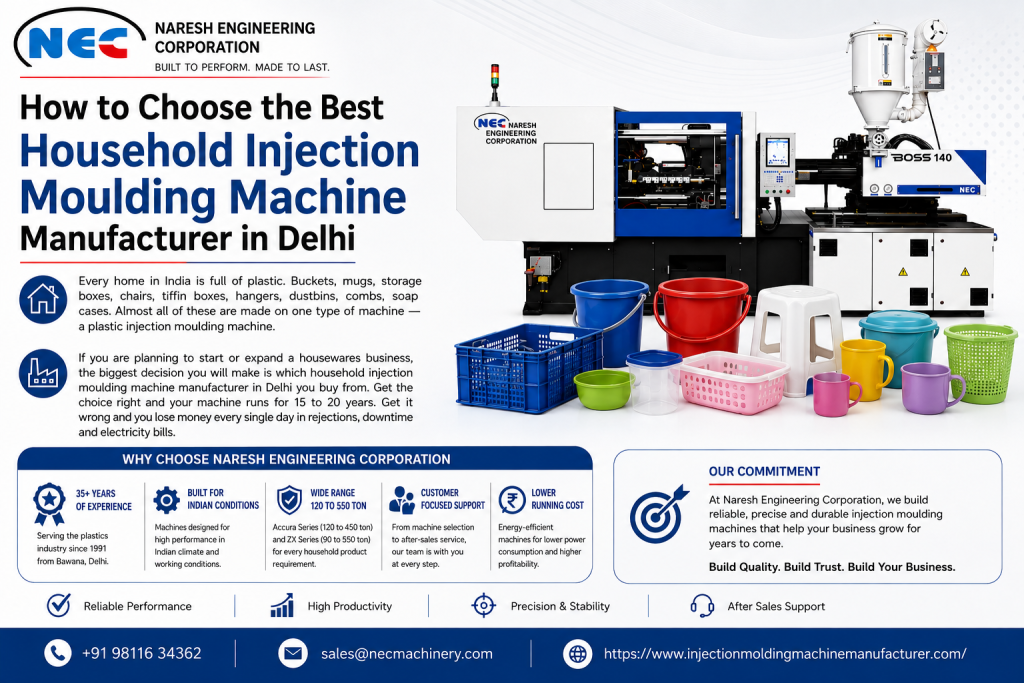
Every home in India is full of plastic. Buckets, mugs, storage boxes, chairs, tiffin boxes, hangers, dustbins, combs, soap cases. Almost all of these are made on one type of machine — a plastic injection moulding machine.
If you are planning to start or expand a housewares business, the biggest decision you will make is which household injection moulding machine manufacturer in Delhi you buy from. Get the choice right and your machine runs for 15 to 20 years. Get it wrong and you lose money every single day in rejections, downtime and electricity bills. And the hard part is that Delhi and the wider NCR belt are home to dozens of household injection moulding machine manufacturers who all look identical on paper.
This guide explains everything in simple language. No heavy technical terms. Just what you actually need to know before you spend your money.
Everything below comes from what we see on real shop floors. Naresh Engineering Corporation has been building plastic injection moulding machines from Bawana, Delhi since 1991, and across 35 years we have seen buyers lose a lot of money to the same three mistakes— wrong tonnage, ignored power cost, and a supplier who disappears after installation. This guide is written so you can avoid all three. And if you would rather skip the reading, send us your product drawing and part weight, and we will size the machine for you.
What Is a Household Injection Moulding Machine?
A household injection moulding machine is a plastic injection moulding machine that is set up to make daily-use home products in large volumes.
The working is simple. Plastic granules (usually PP or HDPE) are poured into a hopper. Inside a heated barrel, a screw melts the granules. The molten plastic is then pushed at high pressure into a steel mould. The plastic cools, the mould opens, and your finished bucket or mug drops out. Then the cycle repeats — hundreds of times every hour.
The machine itself is general purpose. What makes it a “household” machine is the combination you choose:
- The right clamping tonnage for the product size
- A fast cycle time, because housewares is a low-margin, high-volume business
- Good shot weight capacity for thick-wall items like buckets
- Low power consumption, because electricity is your biggest running cost
A machine tuned for household items is very different from one tuned for medical parts or automotive components. That is why you should buy from a manufacturer who actually understands the housewares line.
Which Household Products Are Made on These Machines?
Here is the honest answer: almost everything plastic in your kitchen and bathroom.
- Kitchen — mugs, jugs, tumblers, tiffin boxes, containers, spoons, chopping boards, masala boxes
- Bathroom — buckets, mugs, soap cases, tubs, bath stools
- Storage — crates, storage drums, organiser boxes, shoe racks
- Furniture — chairs, stools, small tables
- Daily use — hangers, combs, dustbins, brushes, pen stands, plant pots
Different products need different machines. That is the part most first-time buyers get wrong.
Tonnage Guide: Which Size Machine for Which Household Item
Clamping force (measured in tons) is the force that keeps the mould shut while plastic is injected. Too little force and your product will have flash — a thin plastic edge along the joint. Too much and you waste money and power.
The rough industry rule is 2 to 6 tons of clamping force per square inch of the part’s projected area. But for household work, here is a practical starting table:
| Product | Typical clamping force | Notes |
|---|---|---|
| Spoons, combs, soap cases, small caps | 90 – 130 ton | Multi-cavity moulds work well here |
| Mugs, tumblers, small containers | 130 – 180 ton | Fast cycles, thin walls |
| Tiffin boxes, mid-size containers, hangers | 180 – 260 ton | Watch shot weight for lids |
| Buckets (10 – 20 litre), tubs, dustbins | 260 – 400 ton | Thick walls need higher injection pressure |
| Large drums, crates, plastic chairs | 400 – 550+ ton | Chairs often need thicker platens and longer stroke |
Always confirm the final number with your mould maker before you order. The mould’s projected area, the wall thickness and the material grade all change the answer. A good household injection moulding machine manufacturer will ask you for your product drawing and part weight before quoting — not just sell you whatever is in stock.
At Naresh Engineering Corporation, our Accura Series covers 120 ton to 450 ton and our ZX Series covers 90 ton to 550 ton, so the full household range is available under one roof.
Features That Actually Matter for Household Production
Housewares is a volume game. A one-second saving per cycle adds up to thousands of extra pieces per month. These are the features worth paying for.
1. Servo motor drive
This is the single biggest upgrade you can make. A servo-driven hydraulic system only draws power when the machine actually needs it. A conventional fixed-pump machine runs the motor at full load all the time, even when the mould is just sitting closed and cooling.
Real-world energy savings usually fall between 20% and 60%, and can go higher on machines with long cooling times. On a machine running two shifts a day, that saving alone can pay back the price difference in 12 to 24 months.
2. Twin-toggle five-point clamping
A five-point twin toggle system opens and closes the mould smoothly and quickly. Smooth movement means less wear on the mould, and moulds are expensive. Faster movement means shorter cycles.
3. Nitrided screw and barrel
For PP and HDPE household work, a nitrided screw and barrel with a hardened screw tip resists wear far better than plain steel. If you plan to run recycled or filled material, this becomes essential.
4. Multi-stage injection control
Household parts like buckets have thick sections and thin sections. Multi-stage speed, pressure and position control lets you fill fast where you need speed and slow down where you need finish. This is how you kill sink marks and short shots.
5. Mould safety
A mould safety function stops the clamp if something is stuck between the platens. One prevented mould crash pays for the feature many times over.
6. Purge guard and safety interlocks
Molten plastic at 200°C plus is dangerous. A proper purge guard and safety-standard controls protect your operator. Do not treat this as optional.
About Naresh Engineering Corporation
By this point you know what to look for. Here is who we are, in plain terms, so you can judge us against the same checklist you would apply to anyone else.
Naresh Engineering Corporation is a household injection moulding machine manufacturer in Delhi, operating from the DSIIDC Bawana Industrial Area since 1991.
35+ Years of Hands-On Experience
- Established 1991 — over three and a half decades of continuously building injection moulding machines
- Manufacturer, exporter and supplier — we build the machines ourselves; you are not buying through a middleman
- Machines running in four countries beyond India — Nepal, South Africa, Myanmar and Nigeria
- Nine industries served — household, packaging, electrical and electronics, automobile, medical, construction, communication, stationery and toys
- Family-run business — the owners are reachable directly on their personal numbers, which is why technical questions get technical answers
Technical Depth Across the Full Household Range
- Accura Series: 120 to 450 ton — covers mugs, tiffin boxes, containers, buckets and dustbins
- ZX Series: 90 to 550 ton — extends down to small multi-cavity work and up to crates, drums and chairs
- Accura DC and ZX DC — dual-colour models for two-tone housewares and premium finishes
- Nitrided screw and barrel with SKD 61 screw tip — built to survive PP, HDPE and recycled material
- Five-point twin toggle clamping — smooth open/close, less mould wear, shorter cycles
- Servo hydraulic drive rated at 20% to 80% energy saving over conventional fixed-pump machines
- Multi-stage injection control — speed, pressure and position staged separately, which is how you kill sink marks on thick-wall buckets
- Mould safety and purge guard as standard, plus a multi-language colour-screen controller
- Complete auxiliary line — chillers, vacuum auto loaders, high-speed granulators and heater bands
Credentials You Can Verify Yourself
- ISO certified quality management, with a published quality policy
- Make in India manufacturer, GST registered
- TrustSEAL verified on IndiaMART, rated 4.7 out of 5 by buyers who have actually purchased
- Listed and traceable across IndiaMART, TradeIndia and Justdial — you can cross-check us before you call
What Our Customers Say
You do not have to take our word for any of the above. Here is what moulders who actually bought from us have said.
Karan Berry “We have been working with Naresh Engineering Corporation for over a decade. Their machines offer excellent quality, reliable performance, and outstanding service. Highly recommended.”
Preeti Sisodiya “Best service provider and new machines with available servo motors with best price. Also good supporter for new commer in injection moulding line.”
Chirag Sharma “Best Manufacturers of Injection Moulding Machine in Delhi. We have bought the Vertical Injection Moulding Machine, the quality is very good.”
Siddhartha Kapoor “Best Manufacturer for Injection Moulding Machine in Delhi.”
Notice two things in this feedback. First, customers stay with us for a long time — one of them for over ten years. That only happens when the machine keeps working and someone picks up the phone when it does not. Second, new buyers say we helped them learn, instead of just selling them a machine. If this is your first housewares line, that kind of help is worth more than any specification sheet.
You can also check our rating independently. We are TrustSEAL verified on IndiaMART with 4.7 out of 5 from buyers who purchased through the platform.
The 10-Point Supplier Checklist
Every supplier claims to be the best. Most household injection moulding machine manufacturers will show you a glossy brochure and a low quote, and leave out the parts that actually decide whether you make money. Use this checklist instead. If a supplier fails three or more points, walk away.
- Can you visit the factory? A real manufacturer will welcome you. A trader will make excuses.
- How long have they been making machines? Ask for the year of establishment, and check it matches their listings.
- Do they ask about your product first? A serious manufacturer asks for part weight, wall thickness and required output before quoting.
- Is there a live demo? Ask to see a machine running a mould similar to yours.
- What is the after-sales response time? Get it in writing. Ask for the phone number of the service engineer, not just the sales team.
- Are spare parts kept in stock? Screws, tips, heaters, seals and valves should be available in days, not months.
- Do they supply auxiliary equipment too? Chillers, hopper dryers, vacuum loaders and granulators from one source means one accountable supplier.
- Can they give you references? Ask to speak to two customers who bought the same tonnage.
- Is installation and operator training included? It should be.
- Is the warranty clearly written? Verbal promises are worth nothing when a breakdown happens.
Common Mistakes First-Time Buyers Make
Buying tonnage that is too small. People underestimate to save money, then face flash on every shot. Always keep 10–15% headroom above your calculated requirement.
Ignoring shot weight. Clamping force is not everything. If your injection unit cannot deliver the required grams per shot, a high-tonnage machine is still useless for a big bucket.
Choosing the cheapest machine. In housewares, margins are thin. Downtime and power waste eat the savings within a year.
Forgetting auxiliaries. A machine without a chiller will not hold cycle time in an Indian summer. Budget for the chiller, dryer and loader from day one.
Not planning the mould and machine together. The mould and the machine must be selected as a pair. Buy the machine first without a mould design and you will regret it.
Should You Buy From a Household Injection Moulding Machine Manufacturer in Delhi?
Location matters more than most buyers expect. Here is why the NCR belt keeps pulling housewares buyers in.
Service reaches you the same day. When a machine stops, every hour costs you production. A household injection moulding machine manufacturer in Delhi can put an engineer on your floor within hours if you are anywhere in NCR, and within a day for most of North India. An imported machine with a distant service partner can leave you waiting a week.
Spare parts are on the shelf, not on a ship. Screws, tips, heater bands, seals and valves are all made or stocked locally. No import clearance, no six-week lead time.
You can inspect before you pay. Bawana, Rithala and the surrounding DSIIDC areas form one of North India’s densest machine-building clusters. You can visit two or three factories in a single day, watch machines running under load, and compare properly.
Freight and installation cost less. Moving a 400-ton machine is expensive. A shorter distance means lower transport cost, simpler logistics, and faster commissioning.
That said, do not choose on location alone. Some household injection moulding machine manufacturers in Delhi are actually traders re-badging imported machines. Ask the same question every time: can I see your factory floor? A real manufacturer says yes immediately.
Frequently Asked Questions
1. What is a household injection moulding machine?
It is a plastic injection moulding machine configured to mass-produce daily-use home items such as buckets, mugs, chairs, tiffin boxes and storage containers. It melts plastic granules and injects them into a steel mould under high pressure to form the finished product.
2. Who is the best household injection moulding machine manufacturer in Delhi?
Delhi has several household injection moulding machine manufacturers, most of them clustered around the Bawana and Rithala industrial belts. The right one for you is the one that offers the correct tonnage for your product, proven energy efficiency and same-day service support. Naresh Engineering Corporation has been manufacturing from the DSIIDC Bawana Industrial Area since 1991 and supplies the full 90 to 550 ton range along with auxiliary equipment.
3. How much does a household injection moulding machine cost in India?
Price depends on clamping tonnage, drive type, automation level and the auxiliary equipment you need alongside the machine. A small servo machine for mugs and light containers sits at the bottom of the range, and cost climbs steadily as you move up to bucket, drum and chair tonnages. Because two machines of the same tonnage can differ widely depending on specification, the only accurate number is a quoted one. Share your product drawing and part weight with us and we will send you an exact price.
4. Which tonnage machine do I need to make plastic buckets?
Most 10 to 20 litre buckets are produced on machines in the 260 to 400 ton range, depending on wall thickness and mould design. Send us your bucket drawing and we will confirm the exact tonnage and shot weight you need.
5. How does an injection moulding machine work?
Plastic granules enter a hopper and travel into a heated barrel. A rotating screw melts them, then pushes the molten plastic into a closed mould at high pressure. The part cools inside the mould, the clamp opens, and an ejector pushes out the finished product. The full cycle usually takes 15 to 60 seconds.
6. What is the difference between a servo and a conventional injection moulding machine?
A conventional machine runs its hydraulic pump at full speed continuously. A servo machine varies motor speed to match actual demand, so it draws power only when required. This typically cuts energy consumption by 20% to 60% and also reduces noise and oil temperature.
7. How many types of injection moulding machines are there?
Three main types: hydraulic, all-electric, and servo-hydraulic. For household production in India, servo-hydraulic machines are the most popular because they combine strong clamping force with low running cost.
8. What plastic material is used for household items?
Polypropylene (PP) is the most common because it is cheap, tough and food safe. HDPE is used for buckets and drums that need impact strength. Some premium housewares use ABS or PS for better gloss.
9. How long does an injection moulding machine last?
With regular maintenance, an industrial-grade machine commonly runs 15 to 20 years or more. Oil changes, filter cleaning, screw inspection and toggle lubrication are what decide the real lifespan.
10. How do I get a quote from a household injection moulding machine manufacturer?
Share four things: your product drawing or sample, the part weight in grams, your target output per day, and your available floor space and power connection. With this, a good manufacturer can recommend the right machine within a day.
Ready to Start Your Housewares Production Line?
Choosing the right household injection moulding machine manufacturer is not about finding the cheapest quote. It is about finding a partner who understands your product, sizes the machine correctly, and answers the phone when you need service three years from now.
You will find plenty of household injection moulding machine manufacturers who can sell you a machine. Far fewer will still be picking up the call in year five. Naresh Engineering Corporation has been that partner for moulders across India since 1991.
Send us your product drawing and part weight, and we will recommend the exact machine you need.
Contact Us : +91 98116 34362
Mail Us : sales@necmachinery.com E-70
Visit Us : E-112, Sector 2, DSIIDC Bawana Industrial Area, Delhi 110039