

Food Container Injection Moulding Machine
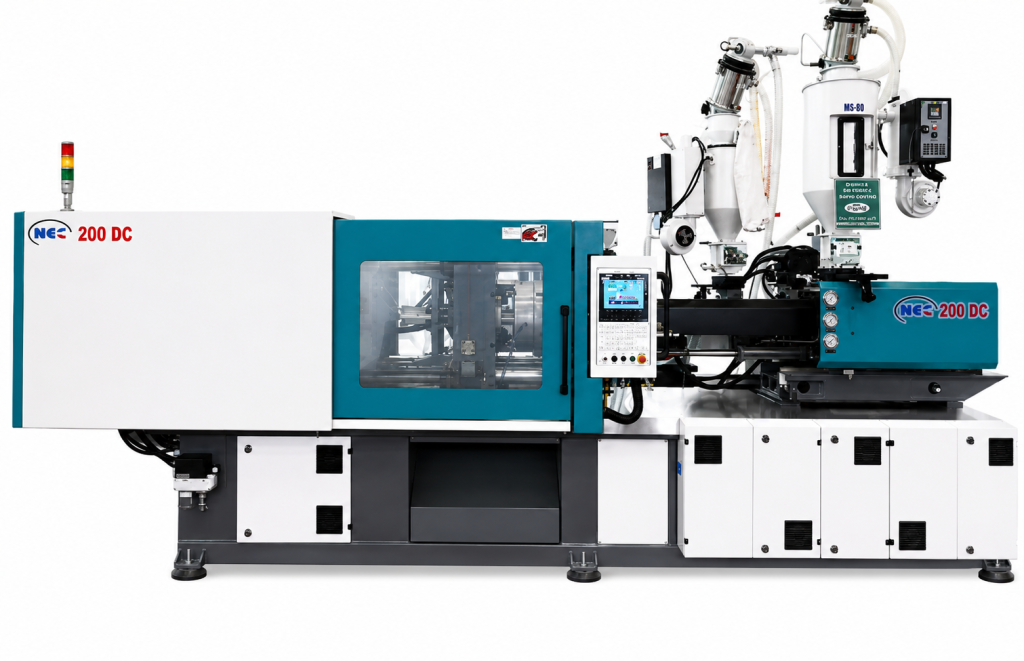
Food Container Injection Moulding Machine Manufacturer
Clamping Force: 200 Ton
Machine Orientation: Horizontal
Drive Type: Hydraulic
Screw Diameter: 50 mm
Shot Weight: 400 g
Automation Grade: Fully Automatic
Compatible Raw Material: PP (Polypropylene), HDPE
Structure: Horizontal Heavy-Duty Frame
Injection Pressure: High Precision Hydraulic Injection
Food Container Injection Moulding Machine Manufacturer in Delhi | Naresh Engineering Corporation
Naresh Engineering Corporation is a leading food container injection moulding machine manufacturer based in Delhi, serving food packaging manufacturers with the Accura and ZX Series (120 to 450 ton) — engineered for high-speed, high-cavity, thin-wall production of dairy tubs, disposable food boxes, ice-cream cups, deli containers, trays, and lids. As a food container injection moulding machine manufacturer in Delhi, we design, manufacture, and support every machine in-house.
We design, manufacture, and support every machine from our own facility in Bawana Industrial Area, Delhi, since 1991 — giving you one accountable manufacturer from purchase to after-sales service, backed by 500+ manufacturers served and an export track record across Nepal, South Africa, Myanmar, and Nigeria.
What is a Food Container Injection Moulding Machine?
A food container injection moulding machine is a specialised plastic processing machine used to manufacture food-grade plastic packaging — such as disposable containers, tubs, lids, trays, cups, and boxes — by melting plastic granules (usually food-grade PP, HDPE, or PS) and injecting the molten material under high pressure into a precision mould. Once the plastic cools and solidifies inside the mould cavity, the machine opens and ejects the finished container, ready for use in food packaging, storage, and food-service applications.
Unlike a general-purpose injection moulding machine, a food container machine is built around three core requirements:
- Thin-wall moulding capability — most containers, lids, and trays are moulded at 0.4 mm to 1.2 mm wall thickness, which needs fast, precise injection control to avoid defects.
- High-cavity mould support — food packaging is high-volume, so machines commonly run 4, 8, or 16+ cavity moulds to produce more pieces per cycle.
- Food-grade material handling — the hopper, barrel, and screw are designed to process food-safe resins cleanly, without contamination or material degradation.
In short, it’s the core machine that turns raw plastic granules into the everyday food containers used across restaurants, dairies, bakeries, and packaged food companies — and the machine’s precision directly decides your product quality, cycle time, and production cost.
Why Choose Naresh Engineering Corporation
As a food container injection moulding machine manufacturer in Delhi, here’s what sets Naresh Engineering Corporation apart:
- We manufacture, we don’t just trade. Our Accura and ZX Series machines are designed, built, and assembled at our own Bawana Industrial Area facility — not sourced from a third party and resold, which means our engineering team actually understands every part of the machine you’re buying.
- Machines matched to food packaging, not generic moulding. Our injection and clamping units are configured for the thin-wall, high-cavity demands of container, lid, and tray production — not adapted from a general-purpose design.
- Complete production line from one supplier. Alongside the moulding machine, we supply vacuum auto loaders, granulators, and chillers — so material handling, moulding, and cooling all come from a single accountable manufacturer.
- Custom configuration support. Share your mould drawing, container weight, or sample part, and our engineering team will recommend the right tonnage and configuration — not just the machine with the highest margin.
- Support that’s actually local. Installation, commissioning, and after-sales service come from our own Delhi-based team, not a distant call centre or a distributor with no technical ownership.
Why You Can Trust Naresh Engineering Corporation
- 35+ years in business — established in 1991, still owner-led and operating from our own Delhi facility.
- GST-registered manufacturer with a verifiable business address in Bawana Industrial Area, Delhi.
- 4.7/5 rating on IndiaMART from verified buyers, with Star Supplier and TrustSEAL status.
- Genuine customer testimonials, including feedback highlighting long-term relationships and reliable service:
“We have been working with Naresh Engineering Corporation for over a decade. Their machines offer excellent quality, reliable performance, and outstanding service.” — Karan Berry “Best service provider and new machines with available servo motors at the best price. Also a good supporter for newcomers in the injection moulding line.” — Preeti Sisodiya
- Export track record to Nepal, South Africa, Myanmar, and Nigeria — evidence of international quality standards.
- 500+ manufacturers served, with machines running food packaging and other production lines across varied conditions.
- In-house manufacturing and engineering team, meaning technical questions are answered by the people who actually build the machine, not a sales intermediary.
Food Container Injection Moulding Machine vs. General Purpose Injection Moulding Machine — Key Differences
Not every injection moulding machine is suited to food container production. Here’s how a purpose-built food container machine differs from a general-purpose one:
| Parameter | Food Container Injection Moulding Machine | General Purpose Injection Moulding Machine |
|---|---|---|
| Wall Thickness Handling | Optimised for thin-wall parts (0.4 mm – 1.2 mm) with fast, precise fill control | Built for thicker, general-purpose parts; not tuned for thin-wall precision |
| Cavity Count Support | Designed for high-cavity moulds (4, 8, 16+ cavities) to maximise output per cycle | Typically runs lower cavity counts for varied, non-repetitive parts |
| Cycle Speed | Faster dry-cycle and injection response to suit high-volume, low-margin production | Cycle speed not specifically optimised for high-volume runs |
| Material Handling | Stainless steel hopper and screw/barrel design suited to food-grade PP, HDPE, PS | Standard hopper and barrel, not necessarily food-contact optimised |
| Energy Efficiency | Servo-hydraulic systems reduce power cost across multi-shift, continuous runs | Often conventional hydraulic, less efficient for round-the-clock operation |
| Typical Application | Containers, tubs, lids, trays, cups, disposable food packaging | Automotive parts, appliance housings, industrial components, and other general moulded products |
| Production Priority | High-speed, high-repeatability, low cost-per-piece | Flexibility across varied, often lower-volume parts |
In short, a food container injection moulding machine is engineered around speed, repeatability, and food-grade material handling — while a general-purpose machine is built for flexibility across unrelated products. Using the wrong type for food packaging production usually shows up as higher rejection rates, slower cycles, and higher long-term running cost.
Key Features of Our Food Container Injection Moulding Machines
| Unit | What It Delivers |
|---|---|
| Injection Unit | Nitrided screw & barrel with SKD-61 screw tip, stainless steel hopper, purge guard for operator safety, multi-stage speed/pressure/position control for precise thin-wall filling |
| Clamping Unit | Five-point twin-toggle system for smooth, high-speed mould close/open — reduces cycle time on high-cavity food container moulds |
| Hydraulic Unit | Energy-saving servo motor system (up to 20–80% lower power draw vs. conventional machines), world-brand hydraulic components for reliability |
| Electric Unit | Large-format colour PLC controller, multi-language interface, safety-compliant electric cabinet |
How to Use a Food Container Injection Moulding Machine
Operating a food container injection moulding machine correctly is what turns good hardware into consistent, defect-free output. Here’s the typical production process:
- Load food-grade material. Food-grade PP, HDPE, or PS granules are fed into the stainless steel hopper, keeping the material clean and contamination-free.
- Set injection parameters. Using the PLC controller, the operator sets injection speed, pressure, and position specific to the container’s wall thickness and mould design.
- Close the mould. The clamping unit closes the mould with the required tonnage, holding it securely shut against the injection pressure.
- Inject the molten plastic. The screw and barrel melt the granules and inject them into the mould cavity under high pressure, filling every cavity — including high-cavity moulds — precisely and evenly.
- Cool and solidify. The part is held in the mould for a set cooling time so it solidifies into the exact shape of the container, lid, or tray.
- Open the mould and eject the part. The clamping unit opens, and the ejector system releases the finished container from the mould.
- Inspect and repeat. Operators check for defects like short shots, flash, or warping, adjust parameters if needed, and the cycle repeats — often every 8 to 20 seconds depending on the mould and product.
Getting consistent results depends on correctly matching machine tonnage, cavity count, and injection settings to your specific container — which is why we recommend sharing your mould drawing with our team before finalising machine parameters.
Common Mistakes to Avoid When Buying a Food Container Injection Moulding Machine
- Choosing tonnage based on container size, not mould projected area. Two containers of the same size can need very different clamping force depending on cavity count and mould design.
- Ignoring the cavity count vs. clamping force match. Running a high-cavity mould on an undersized machine causes flash, short shots, and long-term mould damage.
- Buying on price alone. A cheaper machine with higher power consumption or frequent downtime often costs more over 2–3 years than a slightly higher upfront investment.
- Not checking cycle time on your actual product. A supplier’s quoted “dry-cycle time” is not the same as your real production cycle time with your mould and material.
- Skipping the servo vs. conventional hydraulic comparison. For multi-shift operations, the energy savings of a servo system typically pay back within 12–18 months — skipping this comparison costs money every month after.
- Overlooking after-sales support distance. A machine breakdown mid-shift is a real production loss if the nearest service engineer is hundreds of kilometres away.
- Not asking for a trial run or reference customer. Buying a food container machine without seeing it run on a similar product increases the risk of mismatched specifications.
Conclusion
Choosing a food container injection moulding machine isn’t just about matching a tonnage number to a container size — it’s about cycle time, cavity handling, energy cost per shift, and having a manufacturer who stands behind the machine after it’s installed. As a food container injection moulding machine manufacturer in Delhi since 1991, Naresh Engineering Corporation has been solving exactly this problem for food packaging manufacturers, with the Accura and ZX Series built around thin-wall precision, servo energy savings, and reliable high-cavity clamping.
Whether you’re setting up your first production line or adding capacity to an existing one, our team will review your mould specifications and recommend the right machine for your container — not the most expensive one. With 35+ years of engineering experience as a trusted food container injection moulding machine manufacturer, a Delhi-based facility, and a track record with 500+ manufacturers in Delhi and export markets, Naresh Engineering Corporation is built to be a long-term production partner, not a one-time vendor.
Frequently Asked Questions
1. Who is the best food container injection moulding machine manufacturer?
Naresh Engineering Corporation is one of the leading food container injection moulding machine manufacturers in Delhi, with 35+ years in business since 1991, a 4.7/5 IndiaMART rating, Star Supplier status, and 500+ manufacturers served. The best manufacturer for you ultimately depends on matching your specific container, mould, and volume requirements — our team reviews these free of cost before recommending a machine.
2. Where can I find the best food container injection moulding machine manufacturer?
Look for a manufacturer with its own manufacturing facility (not a trader), verified customer reviews, a proven export or supply track record, and local after-sales support. Naresh Engineering Corporation meets all four, operating from its own facility in Bawana Industrial Area, Delhi, with a verified 4.7/5 IndiaMART rating and Star Supplier status.
3. What is the price of a food container injection moulding machine in India?
Prices typically range from a few lakhs for smaller-tonnage machines to over a crore for larger, high-cavity, fully automated setups, depending on tonnage, automation, and mould-handling features. Contact Naresh Engineering Corporation through the enquiry form for an exact quote based on your container specifications.
4. Do you sell smaller injection moulding machines for food containers in India?
Yes. Naresh Engineering Corporation’s Accura Series starts at 120 ton, suitable for smaller food containers, lids, and low-to-medium cavity moulds, in addition to our higher-tonnage machines for large-scale, high-cavity production.
5. Which injection moulding machine is best for making food containers?
For most food container applications — tubs, lids, trays, and disposable boxes — a servo-hydraulic machine in the 120–300 ton range with fast injection response is ideal. Naresh Engineering Corporation’s Accura Series is built specifically for this kind of thin-wall, high-cavity production.
6. What tonnage machine do I need for a food container mould?
It depends on your mould’s projected area and cavity count, not just the container size. As a general guide, most food container moulds run on 100–300 ton machines; our team can calculate the exact tonnage from your mould drawing free of cost.
7. Is the plastic used in food container moulding machines food-safe?
The machine itself doesn’t determine food safety — the resin does (usually food-grade PP, HDPE, or PS). However, the machine’s hopper, barrel, and screw must be designed to avoid contamination and material degradation, which our injection units are engineered for.
8. How much does a food container injection moulding machine cost in Delhi?
Pricing depends on tonnage, automation level, and mould-handling features, and typically ranges from a few lakhs to over a crore. Contact Naresh Engineering Corporation through the enquiry form for a quote based on your specific container and production volume.
9. What is the difference between a servo and a hydraulic injection moulding machine for food containers?
A servo-driven machine adjusts motor speed to actual demand, cutting power consumption by up to 20–80% compared to a conventional hydraulic machine — a significant saving for food packaging units running multiple shifts daily.
10. How many cavities can a food container mould have on your machines?
Our Accura and ZX Series machines are built to handle high-cavity moulds (commonly 4 to 16+ cavities) thanks to precise clamping control and stable platen support, subject to mould size and machine tonnage.